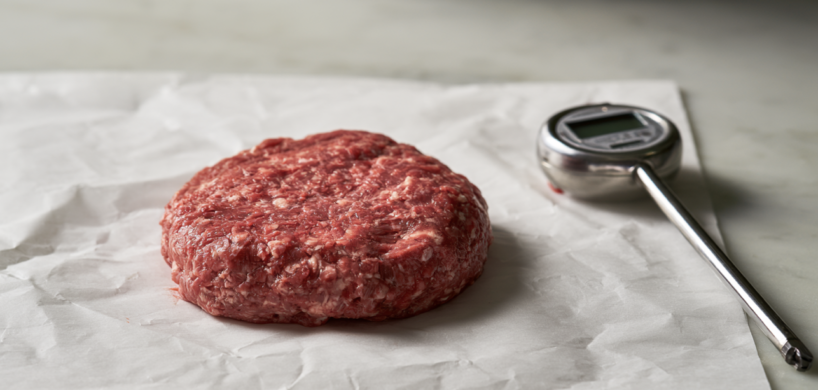

This week the USDA’s Food Safety and Inspection Service (FSIS) added a line to its outbreak investigations table: investigation 2027-01, October 2026, E. coli O157:H7, “Ground Beef (suspect),” active. As Food Safety News reported, there is no case count, no list of states, no named product, and no recall or public health alert. I have asked FSIS to publish what it knows, and I still think it should.
Look at that entry another way, though. It is the first ground beef E. coli O157:H7 outbreak on the FSIS table since November 2024, when Wolverine Packing recalled 167,277 pounds after Minnesota tied 15 illnesses to its ground beef. Two years between hamburger outbreaks. When I started this work in 1993, that would have been unimaginable. It is worth remembering how we got here, who deserves the credit, and what the lesson is for the foods making people sick today.
Where did the progress against E. coli in hamburger start?
It started with the Jack in the Box outbreak of 1992 and 1993: more than 600 people sick and four children dead. President Clinton and his Secretary of Agriculture, Mike Espy, had just taken office. Espy’s USDA launched a public education campaign, required safe handling labels on raw meat and poultry, and in the spring of 1994 recruited Mike Taylor from FDA to run FSIS.
On Sept. 29, 1994, six weeks into the job, Taylor stood before the American Meat Institute convention in San Francisco and said that FSIS considered raw ground beef contaminated with E. coli O157:H7 to be adulterated under the Federal Meat Inspection Act. By his own account, the room went silent. FSIS began testing ground beef on Oct. 17, 1994. Industry groups sued to stop the testing and lost. Texas Food Industry Association v. Espy remains my favorite case.
On July 6, 1996, with parents of children who died in 1993 beside him, President Clinton used his weekly radio address to announce the HACCP and Pathogen Reduction rule, the first real overhaul of meat and poultry inspection in 90 years, finished under Secretary Dan Glickman and Taylor.
Clinton, Espy, Glickman and Taylor took a political risk on behalf of children they would never meet. They were told it could not be done and that it was unfair to hold a company responsible for a bacterium. They did it anyway, and they deserve to be remembered for it.
What did the beef industry and FSIS do?
The industry fought the policy in court and then, to its credit, went to work. After 1993, and especially after ConAgra’s 19.6-million-pound recall in 2002, beef companies adopted test-and-hold sampling, steam pasteurization, organic acid rinses and hot water washes. They dropped suppliers that could not control the pathogen. They began meeting every year to share safety data with competitors and put about $30 million into beef safety research. Buyers such as Costco and Jack in the Box wrote those interventions into their purchasing specifications. Food Safety News told that story on the outbreak’s twentieth anniversary.
FSIS kept testing, moved upstream to beef trim in 2007, and in 2011 declared six more Shiga toxin-producing E. coli to be adulterants, after a petition I filed. Career inspectors and scientists carried that work through administrations of both parties.
How much has E. coli in ground beef declined?
The numbers come from three places, and they agree.
FSIS testing. By the end of 2010, the share of ground beef samples positive for E. coli O157:H7 was down 72 percent from 2000. In 2017, FSIS found 7 positives in 9,761 samples from federal plants, or 0.07 percent. In fiscal year 2024, 27 of 11,563 ground beef samples were positive for any of the seven adulterant strains, or 0.23 percent.

CDC surveillance. CDC reported that E. coli O157 infections fell 42 percent from 1996 to 2004. By 2010 the rate was 0.9 illnesses per 100,000 people, meeting the national health objective of no more than one.
My own practice. From 1993 to 2002, about 90 percent of my firm’s revenue came from E. coli O157:H7 in beef. By 2003 it was about 5 percent. Today it is close to zero. In a 2002 op-ed written after the ConAgra recall, I asked the beef industry to put me out of business. In hamburger, it very nearly has.
That is the best thing to happen in food safety in my lifetime.
What about this outbreak?
Progress is not perfection. Cattle still carry E. coli O157:H7, grinding still spreads it, and ground beef still needs to be cooked to 160 degrees. A rare outbreak is a reason for more openness, not less. If FSIS has traced illnesses to a lot, it should name the establishment and the product. If it has not, it should say how many people are sick and where, so the public can judge the word “suspect” for itself. The system that drove this pathogen down worked because test results were public and consequences were real.
How do we apply the hamburger lesson to other foods?
The beef story has four parts, and none of them is unique to beef.
A clear legal line. E. coli O157:H7 in ground beef is illegal. Salmonella in raw chicken is not. FSIS denied my petition to treat outbreak strains of Salmonella as adulterants and in 2025 withdrew its own proposed Salmonella framework for poultry. CDC said in 2011 that the measures that reduced E. coli O157 needed to be applied more broadly to Salmonella. That is still true.
Government testing, with results the public can see.
Companies began testing seriously once FSIS did. Verification sampling of leafy greens, sprouts and infant formula ingredients would have the same effect.
Accountability at the source. For beef that meant the slaughterhouse, not the kitchen. For romaine and spinach, it means the field, the irrigation water and the cattle operation next door.
Safety as a shared project. Beef companies decided that food safety was not a place to compete and shared what worked. Buyers enforced it through their specifications. Produce buyers have the same power.
Notice what this did not require. Taylor did not wait for a new statute. He applied a law already on the books to a pathogen that was killing children, a court agreed, and a president backed the rule that followed.
If investigation 2027-01 turns out to be ground beef, the answer is the system doing what it was built to do: find it, name it, recall it, fix it. Then do for chicken, lettuce and sprouts what was done for hamburger.
I would be glad to be out of those businesses too.

