
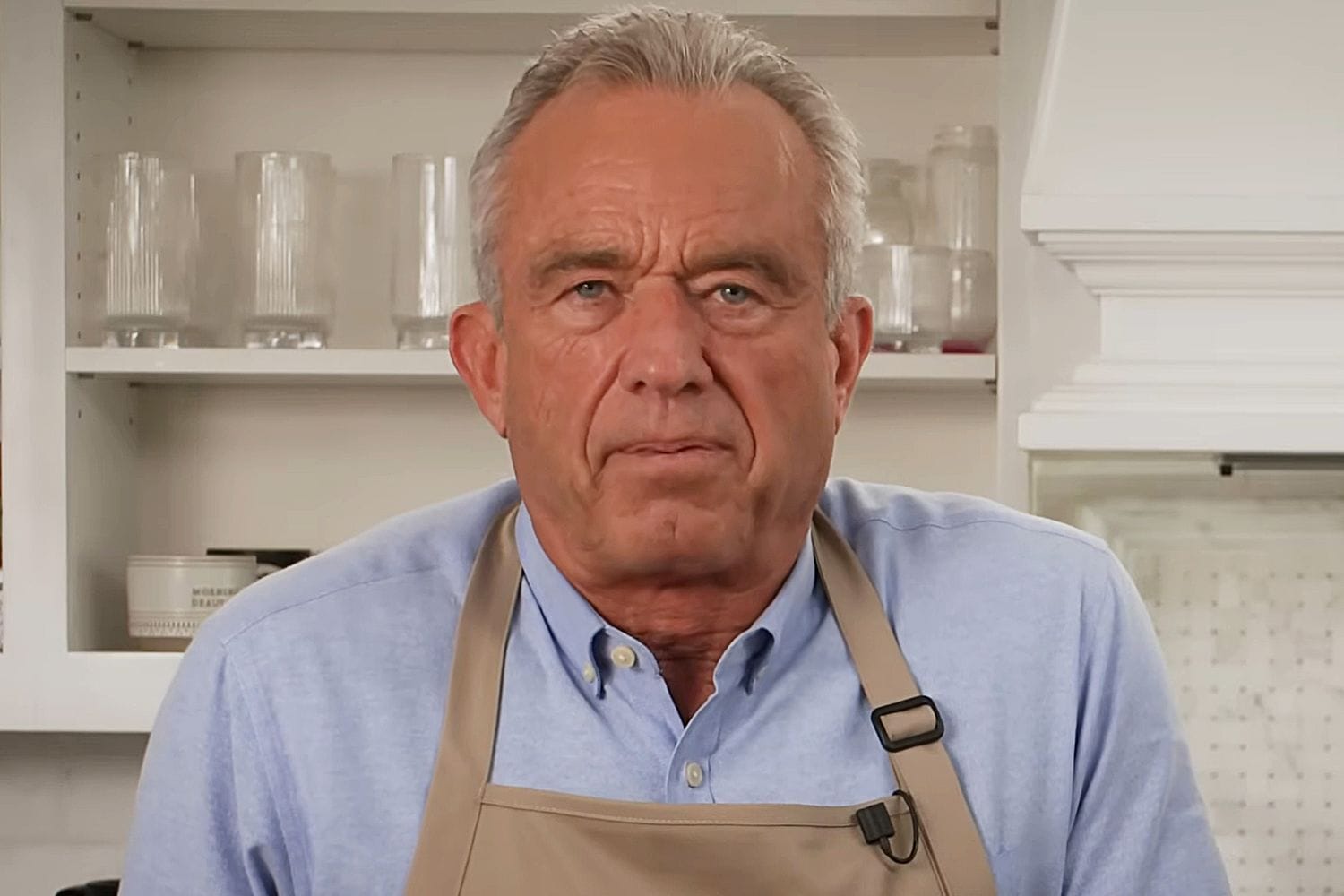
I agree with Robert F. Kennedy Jr. about the thing he cares most about. The American diet is making people sick, ultra-processed food is a real driver of chronic disease, and whole food is better food. I have been arguing versions of that for years and I am not going to stop because it became somebody else’s slogan. Where the Secretary and I part company is on what is standing between his agenda and the grocery cart. This summer the answer is a parasite, and the measurable result is that Americans are eating less fresh produce than they were in May.
The credit for this one belongs up front. Marcia Brown and Sophie Gardner wrote the piece that prompted it, in Politico on August 8. It is careful, it is sourced, and they did the hard part, which was getting people on the record who do not ordinarily line up on the same side of anything. Go read theirs first. What follows is me riffing on their reporting and adding the part I would want the Secretary to read. Twelve days later one of the people they quoted stopped talking through a reporter and wrote it out himself, and I have folded that in below.
Give him the additives half of his agenda, because he has actually moved it.
On August 10 he announced a proposed rule ending self-affirmed GRAS and requiring companies to notify FDA whenever they conclude an ingredient is safe. It published in the Federal Register the next day at 91 FR 51834, docket FDA-2025-N-3262, with comments open through December 9. I have argued for mandatory GRAS notification for a long time, and I will say plainly that no administration before this one proposed it. The same day, HHS and USDA sent the government’s first proposed definition of ultra-processed foods for final review. Neither of those is small. His line that parents should not need a chemistry degree to understand what their children are eating is correct, and I would put it on a slide.
That is the chemistry half of food safety. The other half is biology, and biology has been running the news since May.
Forty percent of Americans say they are buying less produce, and that is a chronic disease outcome.
CBS News and YouGov asked in late July, in the middle of this outbreak, and 40 percent of Americans said they were buying and eating less fresh produce because of it. Four percent said more. A Quinnipiac poll fielded the same week found 55 percent of registered voters with not much confidence or none at all in government oversight of food safety. I put the whole set of them side by side earlier this month, along with the European, British and Canadian numbers, which are flat or rising while ours fall.
Read that 40 percent the way the Secretary should read it. Nobody who quits salad quits eating. They move to the shelf-stable aisle, to the things engineered not to spoil, and they get sick more slowly from something that will never make the news. Susan Mayne, who ran FDA’s Center for Food Safety and Applied Nutrition for eight years, put it as plainly as it can be put in an essay in STAT: consumers should not be faced with a trade-off between nutrition and food safety. That is not an attack on the real food agenda. It is the precondition for it. Every week this outbreak goes unexplained, his own program loses ground on his own metric.
The industry sees it coming before the government does. Joelle Mosso of the Western Growers Association told Politico that retailers have already cut orders in anticipation of falling demand, and that consumers are being handed a message telling them to eat more of the thing they are simultaneously being warned off. I wrote to Western Growers about this in July and I will say the same thing here. The fear outlasts the hazard every time. Onion purchases fell far past anything the recall covered. Chipotle sales sagged for months after an E. colioutbreak that ended long before the customers came back. The recalled lettuce is gone from the shelves, and the produce aisle is still down.
The people making this point are not his opponents.
Jerome Adams, Surgeon General in the President’s first term, told Brown and Gardner the department is urging Americans to eat more fresh produce while warning that the wrong fresh produce will make them badly ill, and cannot say which is which, and that the mixed message is pushing people off salad right now, which is the opposite of what eat real food is supposed to accomplish. Marion Nestle, who has spent a career on this and who has said she supports parts of the MAHA agenda, told them it is hard to tell people to eat real food when the food has pathogens in it. She is right and going after her for saying so was a mistake made by people who ought to be counting her as an ally. Their piece also notes that HHS has held one press call on this outbreak season, and that the Secretary launched a cooking show during it.
The sharpest version came from Frank Yiannas, who was FDA’s top food safety official in the President’s first term and who I have known since his Disney and Walmart days. He told Politico there had been no clear, timely communication about which products were implicated and which were not, or what consumers could actually do, and that the vacuum filled with fear and misinformation. What it cost, he said, was consumer confidence in exactly the foods we want people eating more of. That is a Trump appointee describing the Secretary’s own agenda being damaged by a communications failure rather than by a parasite.
Adams did not leave it at a quote in somebody else’s story. On August 20 he put his name on a column in USA Today headlined that he is a former Surgeon General and the Secretary has the wrong priorities, and he made the argument himself. The sentence at the center of it is the one I have been circling all summer, which is that you cannot effectively focus on chronic disease while acute infectious outbreaks keep overwhelming you. He gets there by way of something the Secretary said before he had this job, which is that we should give infectious disease a break for eight years. Adams calls that a fundamental misunderstanding of public health. It is also the cleanest explanation I have seen of why the produce aisle is down. He then asked for five specific things. One of them is on my list below in nearly the words I would have used. Three of them should have been and were not. One of them is his, and I am leaving it to him.
It is not only the lettuce, and the next one resets the clock.
Set Cyclospora aside for a paragraph. In the same two months, roughly 19 million eggs were recalled over Salmonella that sickened close to a hundred people. A separate Salmonella outbreak traced to jalapenos, which Politico put at more than three hundred people in twenty-seven states in early August, now stands at 431 in thirty-two states with 57 hospitalizations. A dozen people were sickened by E. coli in frozen blueberries. Another dozen got Listeria from soft cheese and one of them died. Add the alfalfa sprouts Minnesota named in the same stretch and that is four live outbreaks at once.
Sandra Eskin, who ran food safety at USDA and now leads Stop Foodborne Illness, put the structural problem to Politico in one sentence: an outbreak like this one, followed a few months later by another, undoes the message entirely. She is right, and it is worse than she says, because the clock does not reset at zero. It resets lower. Each one takes another slice out of the same confidence and none of it comes back on its own.
The numbers behind the fear are not small, and they are still moving.
As of August 24, CDC counts 17,180 laboratory-confirmed cyclosporiasis cases acquired in this country since May 1, with 922 hospitalizations and two deaths, across 48 states and the District of Columbia. Another 11,844 are unconfirmed or need further work. The comparable figure for the same stretch of 2025 was 1,180. A separate 1,805 people caught it while traveling outside the country, 63 of them badly enough to be hospitalized. The outbreak tied to recalled Taylor Farms de Mexico iceberg lettuce accounts for 10,930 of the domestic cases in seventeen states, with at least 454 hospitalizations, as of August 20. My own fifty-state chart, built from what the state health departments publish themselves, stood at 32,506 last night. The season closes on Sunday and the counting will run well past it.
Six things the Secretary could start this week.
Before the list, the fair part. HHS says CDC and FDA have communicated throughout, through social media, continuously updated outbreak pages and ongoing work with reporters, and that consumers have been told to avoid implicated product and see a doctor if they get symptoms. CDC did ask states in early July to report cyclosporiasis weekly rather than monthly, which is a real improvement, and nobody made him do it. And some of what went wrong is structural rather than anybody’s decision about this outbreak. Daniel Jernigan, who ran CDC’s emerging and zoonotic diseases center, describes the parasitic disease program losing capacity as a knock-on effect of the malaria money disappearing, not as a choice anyone made about Cyclospora. The career communications staff who would ordinarily have handled a foodborne outbreak were cut in last year’s reorganization. I am not interested in blaming the people still at their desks in Atlanta and College Park. I am interested in what the man who runs both agencies does next.

These are drawn from a longer list I published on August 7. I have narrowed it to what sits inside his own department, and four of the six need no rulemaking, no appropriation and no act of Congress.
1. Publish one national number and say what it counts. His department currently publishes 10,930, and 17,180, and 29,024 if you add the pending cases, for the same summer, and a reader has no way to know which one answers the question. Pick one, define it, date it, and stand behind it. An agency that will not say how big a problem is cannot expect to be believed when it says the problem is handled.
2. Talk about the outbreak as often as he talks about dinner. One press call, in a season that has now put more than 900 people in the hospital. CDC has posted about it on its X account twice. A commenter under one of his own department’s real food posts asked, in about that many words, whether anybody was ever going to say how to navigate this thing. I have no objection to the cooking show. I object to the ratio. And if the answer is that the people who used to do this work were let go, then hire them back, because a Secretary who briefed the country on this outbreak every week in plain language, naming what is known and what is not, would do more for produce consumption than any recipe.
3. Finish what CDC started on August 20. That day CDC said for the first time that it is genotyping samples from sick people and that the parasites causing these illnesses are genetically related. Read it precisely, because it ties the patients to each other rather than to any product. It is still the first laboratory evidence of any kind in this outbreak, and a day later San Francisco used the same tool to connect one of its own residents to it. Publish the genotype data and fund the capacity to run it everywhere. New York has 939 cases since May and no named source at all, and nobody has asked Albany whether its isolates have been typed. Hawaii, which never received a case of the recalled lettuce, spent yesterday investigating an Oʻahu resident who got sick in July without leaving the islands. Both of those questions are answerable in a laboratory and neither is being answered.
4. Put Cyclospora back in FoodNet. On July 1, 2025, CDC cut the Foodborne Diseases Active Surveillance Network from eight pathogens to two, and this one was among the six dropped. I will be honest about what this ask is and is not. FoodNet measures trends rather than detecting outbreaks and restoring it would not have found this one. It is also the cheapest reversal available to him, it is the single cut he has personally defended, and it is the reason nobody can say with authority how far outside the normal range this summer actually sits. And I am not the only one asking. Last week the former Surgeon General asked for the same restoration in USA Today, all eight pathogens and not one of them optional, and he made the same point about the price of it that I would have made, which is that putting the other six back is a question of prioritization rather than a massive new budget request.
5. Grant the naming petition. Stop Foodborne Illness asked FDA in February to name the companies whose product is implicated in an outbreak. It has been pending since February 5, 2026. That is the same organization whose chief executive Politico quoted on how a second outbreak undoes the message, and the same organization a senior adviser in his department spent a week calling a front group. Consumers cannot avoid what nobody will identify, and in produce, where there is frequently no brand on the item at all, the disclosure has to reach the processor and the grower to be worth anything.
6. Stop delaying traceability. Section 204 is already law. FDA’s own analysis of pushing compliance to July 2028 put the forgone public health benefit above the industry savings, and Congress then wrote the non-enforcement date into an appropriations rider on top of it. He can ask for the rider to come out. I went through the arithmetic and the industry positions on August 25.
Adams asked for three things I did not, and all three of them belong on the list.
He asked the administration to fill the vacancies. FDA has no confirmed commissioner and CDC has a director who was sworn in last month. I had that in my closing paragraph as a reason to go easy on the Secretary. Adams is right that it belongs on the list instead. An acting commissioner can go on CNBC and say the food supply is the safest in the world; a confirmed one can be made to answer for that sentence in a hearing room, under oath, with a transcript. Send the nominations up.
He also asked that the inspectors and epidemiologists who are left be aimed at high-risk foods and at imports, and he named the two foods this summer has actually been about, jalapenos and leafy greens. That is the item on his list I most wish I had written myself. The lettuce came from central Mexico. The jalapenos came from Sinaloa. Import inspection is where the biology of this summer entered the country, and FDA moved its own inspection upstream from the processing plant to the growers in Mexico on August 20, the same day his column ran.
And he asked that whatever international health security money survived the USAID cuts go to targeted partnerships and rapid data sharing in high-risk regions, on the ground that detection abroad protects Americans at home. I would not have thought to put that on a domestic list, and he is right that it belongs there. Every contaminated field in this story was in another country. Our surveillance system met this outbreak at the point where Americans were already in the hospital.
There is a fifth item on his list, on vaccines, and I am not taking it up. Not because I think he is wrong about it. Because it is not what I do, and because the minute food safety gets folded into that argument it stops being something a room of people can agree to fix and starts being a side to be on. I will say only this much. His fourth item and my second are the same instrument. We both want the Secretary to stand at a podium and say a plain sentence out loud. Read his column and take the rest of it up with him.
One more, and it is not on the list because it is not a policy. Spend an hour with a family from this outbreak. One of the 454 people hospitalized, or the family of one of the two who died in Michigan. Not a briefing, not a photograph, not a roundtable with the trade associations in the other chairs. I have been asking people in these jobs to do that since 1993, and I have never watched anyone come out of that hour still able to say a thing is under control.
None of this is partisan, and none of it would have prevented this outbreak.
I want to say both of those plainly, because I would rather say them myself than have them said back to me. The contamination happened in a field in central Mexico in the spring, and no American surveillance program was going to stop it from happening. What these six would have done is make the outbreak shorter, smaller and legible, sooner named and faster traced and honestly counted. And not one of them belongs to a party. The Microbiological Data Program was created under a Republican president and killed under a Democratic one. The traceability rule was written under one administration and delayed under two. The two people who have made this case most plainly in public this month both served in this President’s first term, and one of them made it a week ago on the opinion page of the largest newspaper in the country.
There is one place where I am not asking him to do more. I am asking him to stop.
He campaigned against what he called the government’s aggressive suppression of raw milk. As Secretary he has said he is advocating for it, and he toasted the release of the MAHA report with raw milk in the White House. This is where he and I are not close. Raw milk has no proven nutritional advantage over pasteurized milk and carries something on the order of a hundred times the risk of foodborne illness, a risk that falls hardest on small children. Pasteurization is the most successful food safety intervention in American history. I have kept RealRawMilkFacts.com running for years so that anyone who wants the evidence rather than my opinion can go get it.
Annie Waldman spent months at the country’s largest raw dairy for ProPublica. Federal and state regulators have tied at least 233 illnesses and 40 hospitalizations to that one farm across eight outbreaks since 2006. Its owner told her he had put a couple of kids in the hospital and then called himself a pioneer. I represented one of those kids. He was seven years old in 2006, spent nine days on a ventilator and eighteen days on dialysis after an E. coli O157:H7 infection took his kidneys, and he is twenty-seven now and still under a nephrologist’s care. His mother has spent the twenty years since testifying against raw milk bills in state after state.
Here is the part that belongs in this piece rather than in an old argument. In March, that farm’s raw cheddar was linked to another O157:H7 outbreak, nine people in three states, more than half of them under five, one child with the same kidney complication. CDC told the public to consider not eating it. FDA gave no consumption advice at all. Three federal health employees told ProPublica that political appointees had watered the language down. The company refused to recall for eighteen days and then did it under protest. In January the government had quietly dropped its enforcement effort. Asked in April whether he had a moral responsibility to tell people not to drink raw milk, the Secretary said every product can contain contaminants, and that his department informs the public and lets people make the choice.
Informing the public is the whole job, and it is precisely what his department did not do. You cannot say you are letting people choose and then let your own agencies tell a parent to consider not feeding their toddler the cheese. That is not information. It is a hedge with a child on the other end of it. Every one of the six things above is the same request in a different aisle, which is to say the number, name the product, say the sentence plainly. Raw milk is the aisle where the sentence is easiest to write and where he has been least willing to write it.
The Secretary has the harder job of the two of us. I get to write about this. He has to fix it, and he has to fix it with agencies he has not finished staffing, in the middle of three simultaneous outbreaks. That is an argument for sending the nominations up, not an argument for waiting. He is asking Americans to build their health around fresh, whole, minimally processed food, and this summer a great many of them looked at the lettuce and quietly decided against it. Nobody gets talked back into the produce aisle. You make the produce safe, and then you show your work.

